


Electromagnetic Compatibility in Mission-Critical Defence Electronics
Modern defence platforms increasingly depend on dense electronic architectures containing software-defined radios (SDR), tactical radios, SATCOM terminals, RF transceivers, electronic warfare systems, radar, navigation equipment, secure communication systems, unmanned platforms, command-and-control electronics, surveillance systems, electro-optical systems, weapon-control electronics and high-speed digital processors. These systems operate in an extremely challenging electromagnetic environment where multiple transmitters, receivers, switching power converters, high-current DC buses, motors, generators and RF systems may operate simultaneously in close proximity. In such applications, EMI is not simply an equipment-compliance issue; uncontrolled electromagnetic interference can reduce receiver sensitivity, increase noise floors, cause communication errors, desensitize RF front ends, interfere with navigation and potentially compromise mission-critical functionality.
BLA ETech specifically positions its Military & Custom solutions for demanding defence applications, including military-grade EMI filters, shielding solutions and surge-protection systems, with customized designs for specific military requirements. BLA also states that its military products undergo stringent testing and are developed for integration into existing military infrastructure.
EMI Generated by Modern Military Power Electronics
Modern military electronics increasingly use high-frequency DC-DC converters, isolated converters, MOSFET/IGBT/SiC switching stages, battery-management systems, power-conditioning units, motor drives, servo systems and high-density embedded power supplies. These devices improve power density and efficiency but generate substantial high-frequency energy through rapid switching transitions. A switching node with high dv/dt can capacitively inject common-mode current into chassis and cable structures, while high di/dt creates magnetic coupling and differential-mode disturbances.
The resulting interference can propagate through 28 VDC vehicle power buses, aircraft electrical systems, shipboard power networks, battery systems, generator outputs, RF equipment power supplies, communication cables, grounding structures and equipment chassis. BLA's engineering approach is to identify the source and frequency spectrum of the interference and then control the propagation path using the appropriate combination of EMI filters, inductive components, capacitive filtering, common-mode suppression and surge/transient protection.
Military Radio Communication and the Noise Problem
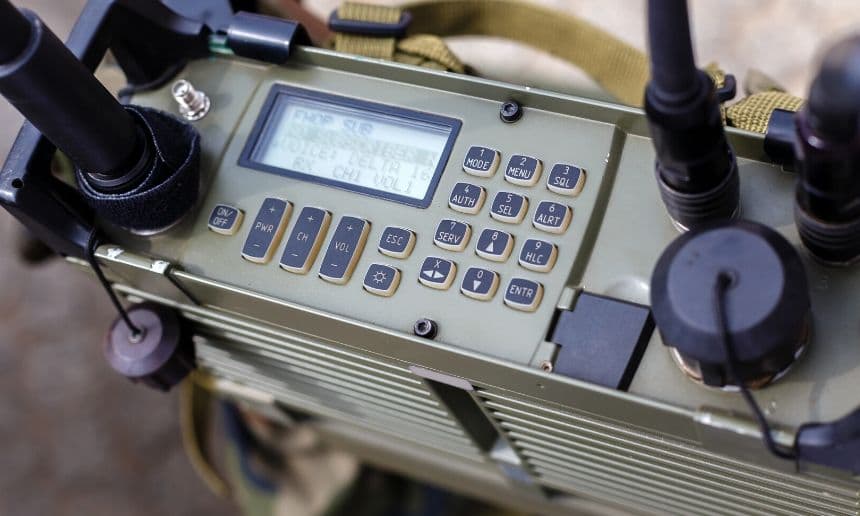
Military radio systems create an especially demanding EMC environment because the receiver and transmitter may be operating within the same platform alongside high-power digital electronics. Tactical radios, SDRs, HF/VHF/UHF radios, SATCOM terminals, data links and RF surveillance systems require very low unwanted noise at their sensitive receiver inputs.
A switching power supply operating several centimetres away from an RF receiver can generate harmonics that extend far beyond its nominal switching frequency. These components can couple through the DC supply, chassis, cable harness or radiated electromagnetic fields. BLA can address these problems through DC EMI filters, common-mode chokes, differential-mode filters, ferrite beads, ferrite cores, feedthrough filters, signal-line filters and multi-stage LC networks, with the filter topology selected according to the required frequency attenuation and RF environment.
Conducted EMI and Military Power Interfaces
Conducted emissions are particularly important in defence platforms because several subsystems often share the same power-distribution network. Noise generated by a radar processor, radio transmitter, motor controller or DC-DC converter can travel along a common power bus and enter another subsystem.
BLA provides single-phase EMI filters, three-phase EMI filters, DC EMI filters, high-current DC filters, common-mode chokes, differential-mode inductors, line reactors and custom power-entry filters to interrupt these conducted-noise paths. The filter can be designed so that the equipment presents a controlled electrical interface to the platform power system while maintaining the required voltage, current and transient performance.
MIL-STD-461 and Military EMC Requirements
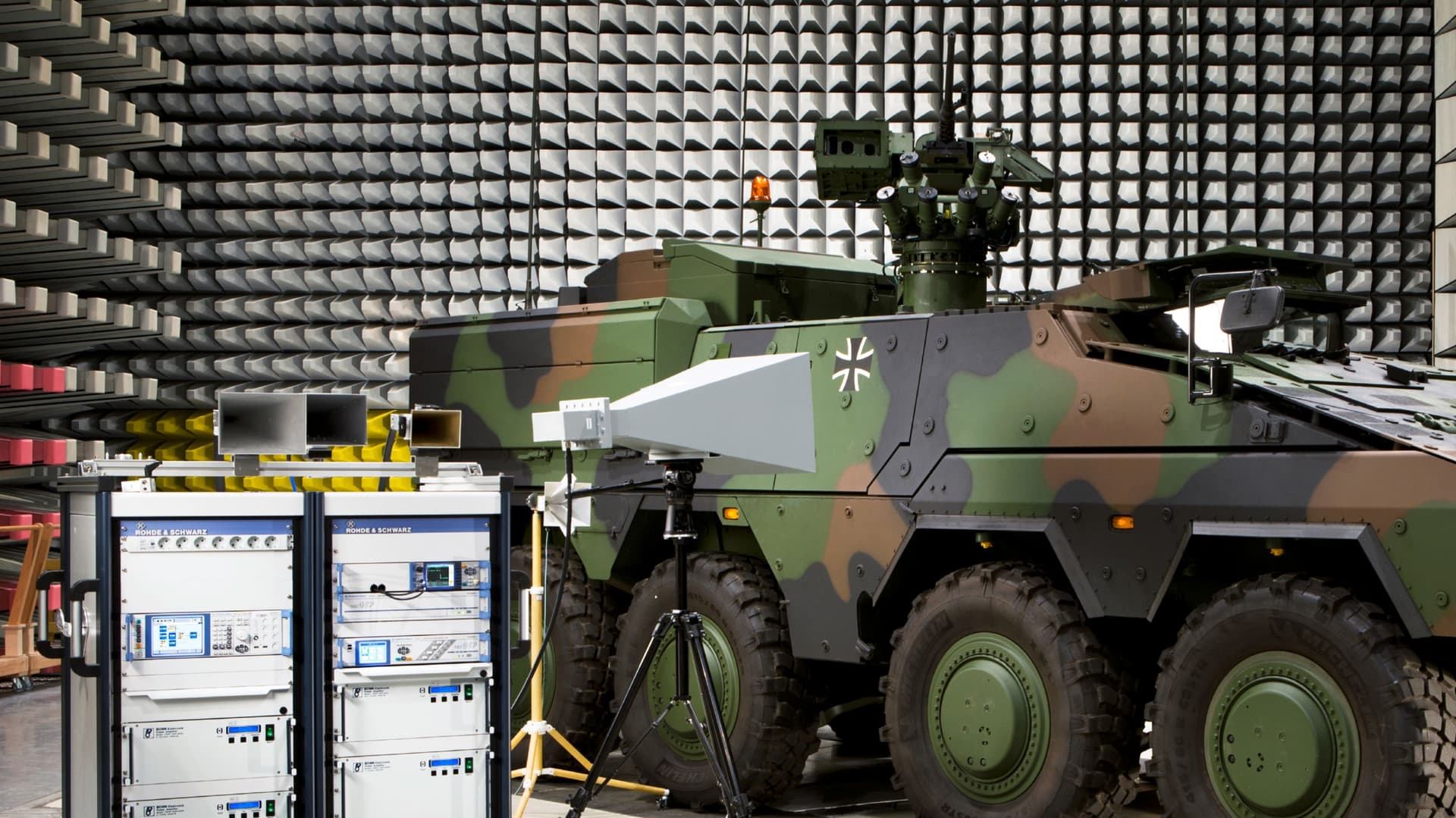
For defence electronics, one of the most important EMC references is MIL-STD-461, which establishes requirements and verification methods for controlling electromagnetic interference emission and susceptibility characteristics of electronic, electrical and electromechanical equipment and subsystems used by U.S. Department of Defense activities and agencies. The current DLA record describes the standard as covering both EMI emissions and susceptibility, including equipment-level requirements for conducted and radiated electromagnetic behaviour.
MIL-STD-461 is particularly important because it does not only ask whether equipment produces excessive noise. It also addresses whether the equipment can withstand electromagnetic disturbances generated by other equipment operating on the same platform. This creates two engineering requirements: the equipment must be a sufficiently quiet electromagnetic neighbour, and it must also be sufficiently immune to the electromagnetic environment around it.
BLA designs military EMI filter architectures with these two requirements in mind. Depending on the applicable contractual requirement, filter design can target conducted emissions, conducted susceptibility, radiated emissions and radiated susceptibility. BLA's own military-specific material explicitly describes military-grade EMI filters, shielding and surge protection as tools for improving EMC and protecting sensitive electronics and communications.
Conducted Emission Control Through EMI Filters
Conducted emissions generally enter or leave an equipment enclosure through its electrical interfaces. BLA can develop AC EMI filters, DC EMI filters, single-phase filters, three-phase filters, three-phase-plus-neutral filters and custom high-current power-line filters to attenuate unwanted energy.
A military filter may incorporate several filtering mechanisms simultaneously, including common-mode inductance, differential-mode inductance, X capacitors, Y capacitors, ferrite elements and damping networks. The objective is to produce sufficient attenuation over the frequency range of interest without creating excessive voltage drop, thermal losses, leakage current or resonant peaks.
For a radio system, for example, the required filter performance may be dictated not by the power supply's switching frequency itself but by the frequencies at which its harmonics overlap with sensitive receiver bands.
Common-Mode Chokes for Tactical Electronics
Common-mode currents are a major concern in military communication equipment because they can travel along both power conductors and cable shields relative to chassis. BLA manufactures common-mode chokes and common-mode inductive assemblies that introduce high impedance to common-mode currents while allowing the required differential or power current to pass.
For high-current military applications, the magnetic design can be optimized for DC bias, saturation flux density, copper loss, core loss, temperature rise, leakage inductance and high-frequency impedance. For radio-frequency applications, parasitic winding capacitance also becomes important because excessive inter-winding capacitance can provide an unintended high-frequency bypass path.
Differential-Mode Chokes and LC Filtering
Common-mode suppression alone is insufficient when the noise exists between conductors. BLA can therefore combine differential-mode chokes, series inductors, X capacitors and LC filtering networks to address differential-mode noise.
In military power electronics, the filter must be carefully designed around the converter's source and load impedance. An improperly damped LC network can resonate with the converter's input impedance and produce an impedance peak. BLA's customized approach allows the filter to be designed around the actual switching spectrum and electrical architecture rather than using a generic capacitance-inductance combination.
28 VDC Military Vehicle Power Systems
Military ground vehicles commonly use a 28 VDC electrical architecture. MIL-STD-1275 defines operating voltage limits and transient-voltage characteristics at the input terminals of utilization equipment connected to military ground-vehicle electrical systems. The current DLA record identifies MIL-STD-1275 as an active standard.
This environment is particularly challenging because vehicle electrical systems can experience voltage transients, load switching disturbances, generator behaviour and high-current switching events. BLA can engineer 28 VDC EMI filters, transient suppression filters, common-mode chokes, differential-mode filters, DC chokes and surge-protection networks for military vehicle electronics.
For equipment intended to meet a specific procurement requirement, the exact applicable revision, test method and contractual limits must be established before claiming compliance.
Aircraft Power and MIL-STD-704
Aircraft electronics operate from tightly controlled but demanding electrical power systems. MIL-STD-704 establishes the characteristics of aircraft electric power supplied at equipment input terminals, while the MIL-HDBK-704 series provides guidance for demonstrating utilization-equipment compatibility with those power characteristics. The current DLA record for MIL-STD-704 was updated in June 2026.
An important technical distinction is that MIL-STD-704 itself addresses aircraft electrical power characteristics and does not itself cover EMI or voltage spikes; those aspects must be addressed through the applicable complementary requirements and equipment specifications. BLA can therefore design aircraft power-input filters and associated suppression networks around the combined electrical and EMC requirements of the specific platform.
Naval and Shipboard Electronics
Naval platforms present another difficult EMC environment because radios, radar, navigation, propulsion systems, power converters and high-power transmitters operate within the same electrically interconnected platform. Shipboard electrical compatibility is addressed through the MIL-STD-1399 family, which establishes electrical interface characteristics between shipboard power systems and equipment.
For example, MIL-STD-1399 Section 300-1 covers low-voltage AC shipboard power, while related sections address medium-voltage and DC power interfaces. The current DLA documentation describes these standards as establishing electrical interface characteristics and verification requirements for shipboard equipment.
BLA can develop three-phase EMI filters, AC line reactors, DC filters, common-mode chokes, differential-mode chokes and custom power-entry filters for naval electronic subsystems where the applicable shipboard interface requirements demand controlled interaction with the platform power network.
MIL-STD-810 Environmental Engineering
Military EMI components cannot be considered only from an electrical perspective. Filters installed in vehicles, aircraft, naval platforms or field-deployed communication equipment can experience vibration, mechanical shock, temperature extremes, humidity and other environmental stresses.
MIL-STD-810 provides environmental engineering and laboratory-test guidance for military materiel. Importantly, it is an environmental tailoring standard rather than a universal pass/fail specification that automatically applies identically to every product. The current DLA description explicitly states that the standard provides engineering direction for tailoring environmental stresses and test methods to the actual materiel and service environment.
BLA can therefore engineer filter construction, magnetic components, mounting, encapsulation, enclosure design and terminal arrangements around the environmental profile specified by the defence OEM or system integrator.
Shielding and Conductive EMI Gaskets
Filtering alone cannot solve every military EMC problem. RF energy can enter or leave an enclosure through seams, doors, connector panels, cable apertures and mechanical interfaces. BLA's military-specific offering includes shielding solutions, and conductive EMI/RFI gasket technology is an important part of enclosure-level EMC engineering.
MIL-DTL-83528 is an active U.S. military specification covering conductive elastomeric shielding gaskets for EMI/RFI suppression. Current DLA records include connector-flange, O-ring, D-strip, P-strip, channel-strip and other gasket configurations.
Where required by a customer's design specification, BLA can integrate conductive shielding, filtered interfaces and EMI filter assemblies into a coordinated enclosure-level EMC strategy.
Feedthrough Filters and RF Boundary Control
Military radio and communication equipment often requires a controlled RF boundary between internal electronics and the external cable environment. A cable passing through an enclosure can otherwise become an efficient conducted and radiated coupling path.
BLA can provide feedthrough EMI filters, feedthrough capacitors, filtered terminal assemblies and chassis-mounted EMI filters designed to place the filtering function directly at the enclosure boundary. This minimizes the length of the unfiltered conductor inside the equipment and provides a more effective high-frequency return path to the chassis.
The mechanical connection between the filter and enclosure is particularly important at RF because even a small parasitic inductance can significantly reduce high-frequency attenuation.
High-Frequency Ferrite and Magnetic Suppression
At higher frequencies, ferrite cores, ferrite rings, ferrite beads and cable-mounted ferrites can provide substantial impedance to unwanted noise currents. BLA can select ferrite materials and geometries according to the required frequency range, current level and installation configuration.
For military radios, ferrite suppression may be applied to DC supply cables, RF control wiring, data interfaces, sensor wiring, power-converter outputs and cable harnesses. The ferrite must be selected according to its complex impedance versus frequency rather than simply its nominal inductance.
Surge, Transient and Power-Line Protection
Military equipment can also encounter fast electrical transients caused by switching loads, generators, inductive actuators and platform power-system disturbances. BLA's military-specific offering includes surge protection systems alongside EMI filtering and shielding.
A coordinated protection architecture can therefore combine surge suppression, transient filtering, common-mode filtering, differential-mode filtering and energy-absorbing components. This is particularly important where the equipment's power interface must survive both steady-state electrical disturbances and fast transient events.
RF Receiver Protection and Electromagnetic Isolation
The receiver section of a tactical radio is often much more sensitive than the transmitter's power electronics. Strong RF fields generated by nearby transmitters can couple into power and signal interfaces and potentially desensitize the receiver.
BLA can approach this problem by combining DC EMI filters, common-mode chokes, feedthrough filters, ferrite components, conductive shielding and controlled chassis bonding. The objective is to reduce conducted coupling while maintaining the required DC power and RF system performance.
The filter must also avoid introducing unwanted resonances or excessive parasitic capacitance that could create a new RF coupling mechanism.
Software-Defined Radios and Modern Digital RF Systems
Modern military radios increasingly use software-defined radio architectures, high-speed ADCs/DACs, FPGA processing, digital beamforming, networked data interfaces and high-speed serial links. These architectures create a mixture of analogue RF, high-speed digital and switching-power noise sources within the same enclosure.
BLA can develop power-entry EMI filters, DC-DC converter input/output filters, common-mode chokes, ferrite suppression, signal-line filters and feedthrough filters for these architectures. The design must preserve low noise on sensitive analogue and RF supply rails while preventing high-speed digital switching currents from coupling into RF circuitry.
Radar, Electronic Warfare and High-Power RF Platforms
Radar and electronic-warfare platforms present particularly complex EMC environments because high-power RF transmitters operate alongside extremely sensitive receivers, processors, power electronics and control systems. Harmonics, switching transients and common-mode currents generated by supporting power electronics can become unwanted contributors to the electromagnetic environment.
BLA's custom EMI filters, high-current inductors, common-mode chokes, DC filters, feedthrough filters, shielding solutions and surge-protection architectures can be engineered for these subsystems. The key engineering objective is to prevent power-electronic noise from becoming an unintended RF source while also protecting sensitive electronics from external electromagnetic energy.
Military Communication Vehicles and Mobile Command Systems
Mobile command vehicles combine radios, satellite communication, computing, displays, navigation, surveillance, power converters, batteries and vehicle electrical systems within a confined platform. This creates numerous potential EMI coupling paths.
BLA can develop 28 VDC input filters, DC chokes, common-mode filters, differential-mode filters, power-entry filters, ferrite assemblies and shielded/filtered interfaces around the vehicle architecture. For systems subject to MIL-STD-1275 and MIL-STD-461 requirements, the filter design can be developed around the specific applicable test methods and limits.
Standards-Based Engineering Rather Than Generic Filtering
A critical distinction for military applications is that saying a product is "military grade" is not equivalent to demonstrating compliance with a particular military standard. BLA's military-specific page emphasizes stringent standards, testing and military specifications, while its product offering is explicitly positioned around military-grade EMI filters, shielding and surge protection.
For an actual defence program, BLA can design the product to the applicable customer-specified standard, revision, platform category and test requirement, and the final compliance claim should be supported by the applicable qualification or verification evidence. This is particularly important for MIL-STD-461 because the applicable requirement depends on the intended installation and platform. The standard itself states that requirements vary according to the intended installation and that applicable limits and verification procedures must be established for the equipment.
Customized Military EMI/EMC Engineering by BLA
BLA's strength in military applications is the ability to combine multiple technologies rather than treating EMI as a single-component problem. A military communication system may require a DC EMI filter + common-mode choke + differential-mode inductance + ferrite suppression + feedthrough filtering + shielding + surge protection. A vehicle-mounted system may additionally require a 28 VDC transient-rated filter. An aircraft subsystem may require an input filter designed around MIL-STD-704 power characteristics, while a shipboard system may require filtering compatible with the applicable MIL-STD-1399 interface.
BLA can therefore engineer single-phase EMI filters, three-phase EMI filters, DC EMI filters, 28 VDC military filters, high-voltage DC filters, common-mode chokes, differential-mode chokes, AC line reactors, DC reactors, DC link chokes, ferrite cores, ferrite beads, feedthrough filters, signal-line filters, data-line filters, X/Y capacitor networks, surge-protection systems, shielding solutions and custom magnetic components according to the electrical and environmental requirements of the application.
BLA — Military EMI/EMC and Radio Communication Solutions
From tactical radios, software-defined radios and SATCOM equipment to radar, electronic warfare, military vehicles, aircraft electronics, naval systems, surveillance equipment, command-and-control platforms and unmanned systems, BLA provides customized EMI/EMC and noise-suppression solutions designed around mission-critical electronics.
The engineering philosophy is straightforward: identify the noise source, characterize the frequency spectrum, determine the coupling path, select the correct suppression technology and validate the complete equipment against the applicable requirements.
BLA's military solutions can combine EMI filtering, common-mode suppression, differential-mode filtering, DC filtering, transient and surge protection, ferrite suppression, feedthrough filtering and electromagnetic shielding into one coordinated architecture.
BLA — Mission-Critical EMI/EMC Engineering for Defence and Radio Communication.
Control conducted noise. Suppress common-mode currents. Protect sensitive RF electronics. Maintain signal integrity. Build for the electromagnetic environment.
From the power input to the RF interface, BLA engineers the electromagnetic protection around the mission.
Ready to revolutionize your Military & Radio Communication operations?
Contact Bla Etech today for a consultation and discover how our cost-efficient solutions can elevate your business while aligning with timely delivery.
Contact us

