


Managing Electromagnetic Interference in Medical Equipment
Medical equipment combines highly sensitive electronics, precision measurement systems, high-speed processors, switching power supplies, motors, pumps, imaging electronics and communication interfaces within compact equipment enclosures. In such environments, even relatively low levels of unwanted electrical noise can affect measurement accuracy, signal integrity, communication, image quality or equipment reliability. Electromagnetic interference (EMI), radio-frequency interference (RFI), common-mode noise, differential-mode noise, conducted emissions, radiated emissions, transient disturbances and power-line disturbances therefore require careful control. BLA provides customized EMI/EMC filters, chokes, inductors, reactors, ferrite suppression components and signal-line filtering solutions for medical equipment manufacturers requiring controlled electromagnetic performance.
Sources of EMI in Medical Electronics
Modern medical equipment contains numerous high-frequency switching circuits. SMPS power supplies, DC-DC converters, inverter circuits, motor drives, electrosurgical generators, LED drivers, battery chargers, pumps, compressors and digital processing systems can all generate high-frequency electrical noise. Switching semiconductor devices produce rapid voltage and current transitions, resulting in high dv/dt and di/dt. These transitions can generate broadband noise extending well beyond the fundamental operating frequency of the equipment.
The noise can propagate through AC mains connections, DC supply rails, protective earth, chassis structures, internal wiring, communication cables and sensor connections. It can also couple capacitively or inductively into sensitive measurement circuits. BLA's engineering approach is therefore based on understanding the noise source, frequency spectrum, propagation path and affected circuit before determining the appropriate suppression technology.
Common-Mode Noise in Medical Equipment
Common-mode noise occurs when unwanted high-frequency current flows in the same direction on multiple conductors relative to a reference such as chassis or earth. In medical equipment, this can be particularly important because sensitive electronic circuits may operate with very small signal levels.
BLA can provide common-mode chokes, common-mode inductors, ferrite cores and common-mode EMI filter assemblies to increase impedance to unwanted high-frequency currents. The magnetic component can be engineered according to operating current, frequency range, required attenuation, temperature rise and allowable insertion impedance.
For equipment containing multiple internal power-conversion stages, common-mode filtering may be implemented at the mains input, DC bus, subsystem power input or signal interface depending on the actual noise path.
Differential-Mode Noise
Differential-mode (DM) noise exists between conductors—for example, Line-to-Neutral on a single-phase AC supply or between positive and negative DC conductors. Switching power supplies and converter circuits can generate high-frequency ripple currents that propagate through these paths.
BLA can control differential-mode noise using differential-mode chokes, series inductors, LC filters and X capacitors. The filter is designed around the equipment's switching frequency, noise spectrum, load impedance and required attenuation.
This is particularly important in precision medical electronics where unwanted supply ripple or high-frequency components can potentially couple into analogue front ends, sensor circuits and measurement electronics.
Single-Phase EMI Filters for Medical Equipment
A large proportion of medical equipment operates from a single-phase AC supply. BLA provides single-phase EMI filters and single-phase RFI filters for equipment such as patient monitoring systems, laboratory equipment, diagnostic instruments, medical imaging subsystems, electronic beds, medical pumps, dental equipment and other electrically powered medical systems.
A typical filter may combine a common-mode choke, differential-mode inductance, X capacitor, Y capacitors and damping components. Component values can be selected to achieve the required attenuation while maintaining appropriate leakage-current characteristics and power-frequency performance.
For medical applications, filter design must consider not only EMI attenuation but also leakage current, dielectric withstand, insulation coordination, thermal performance and long-term reliability.
DC EMI Filters and Internal Power Rails
Many medical devices use multiple internal DC rails, such as 5 V, 12 V, 24 V, 48 V or higher DC buses generated through switching power supplies and DC-DC converters. These internal supplies can become pathways through which high-frequency noise travels from one subsystem to another.
BLA can develop DC EMI filters, DC power-line filters and multi-stage LC filtering networks for internal power architectures. These filters can be placed between noisy power-conversion stages and sensitive electronics to reduce conducted noise propagation.
This approach is particularly useful where a switching power supply is located close to analogue measurement electronics, sensors, communication circuits or data-acquisition systems.
Common-Mode Chokes for Switching Power Supplies
Switch-mode power supplies are one of the most common sources of EMI in modern medical equipment. Fast switching currents can create both common-mode and differential-mode noise.
BLA can supply common-mode chokes and custom magnetic components for AC input filters and DC power-supply stages. The choke can be designed according to rated current, winding configuration, core material, frequency response, saturation characteristics and thermal requirements.
For compact medical equipment, BLA can also customize the mechanical construction of the choke to fit the available PCB or enclosure space.
Ferrite Cores and Ferrite Beads
Ferrite cores, ferrite rings, ferrite beads and cable ferrites are valuable tools for high-frequency noise suppression. Unlike conventional low-frequency inductors, ferrite materials can provide substantial impedance over selected high-frequency ranges.
BLA can provide customized ferrite suppression for power cables, sensor wiring, communication cables, motor connections and internal harnesses. Ferrite selection depends on the frequency spectrum of the interference, cable configuration, current level and required attenuation.
Ferrites can be particularly useful when the noise is localized to a specific cable or when additional high-frequency attenuation is required without significantly affecting the normal DC or low-frequency operating current.
EMI Filters for Medical Imaging Equipment
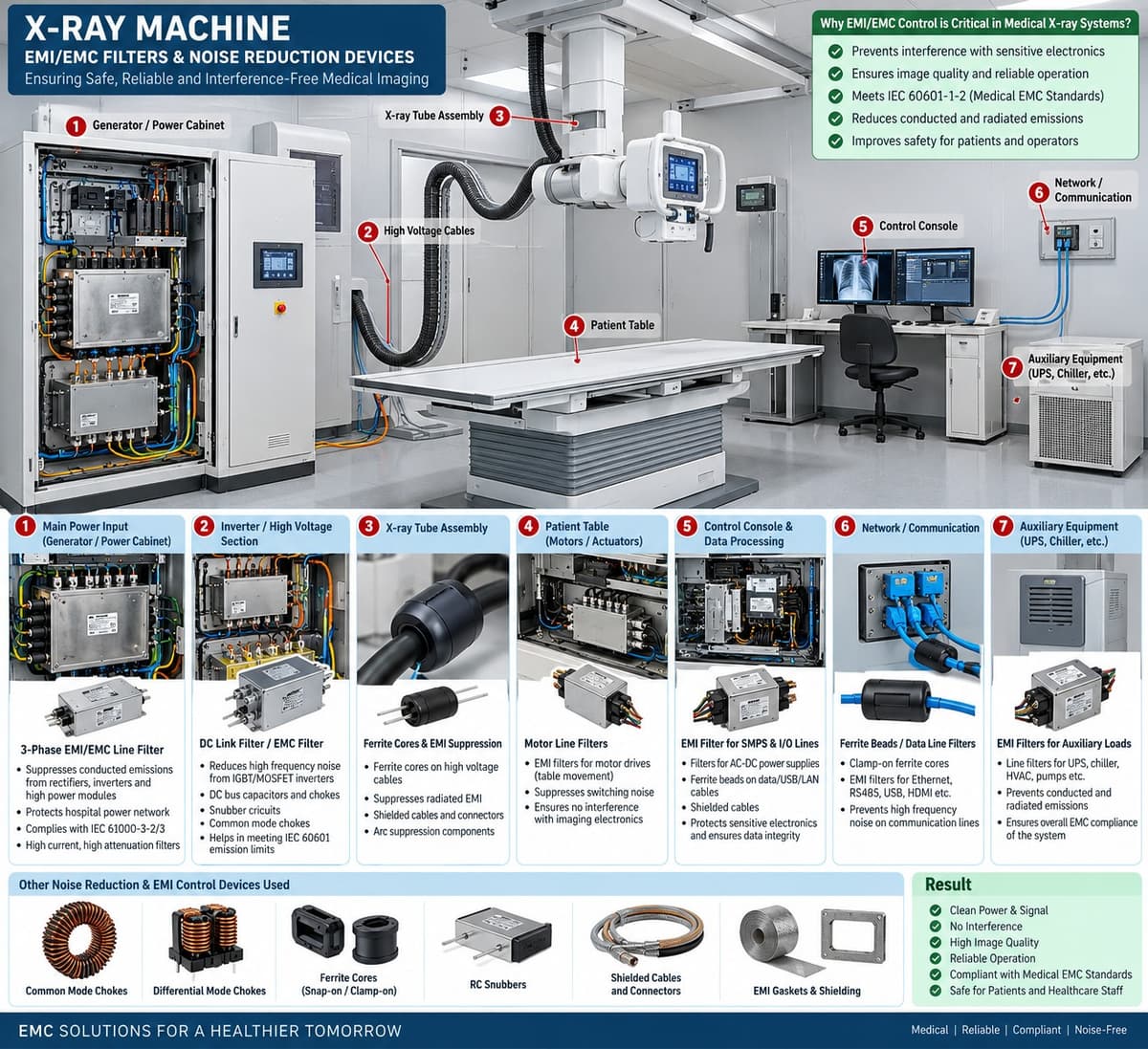
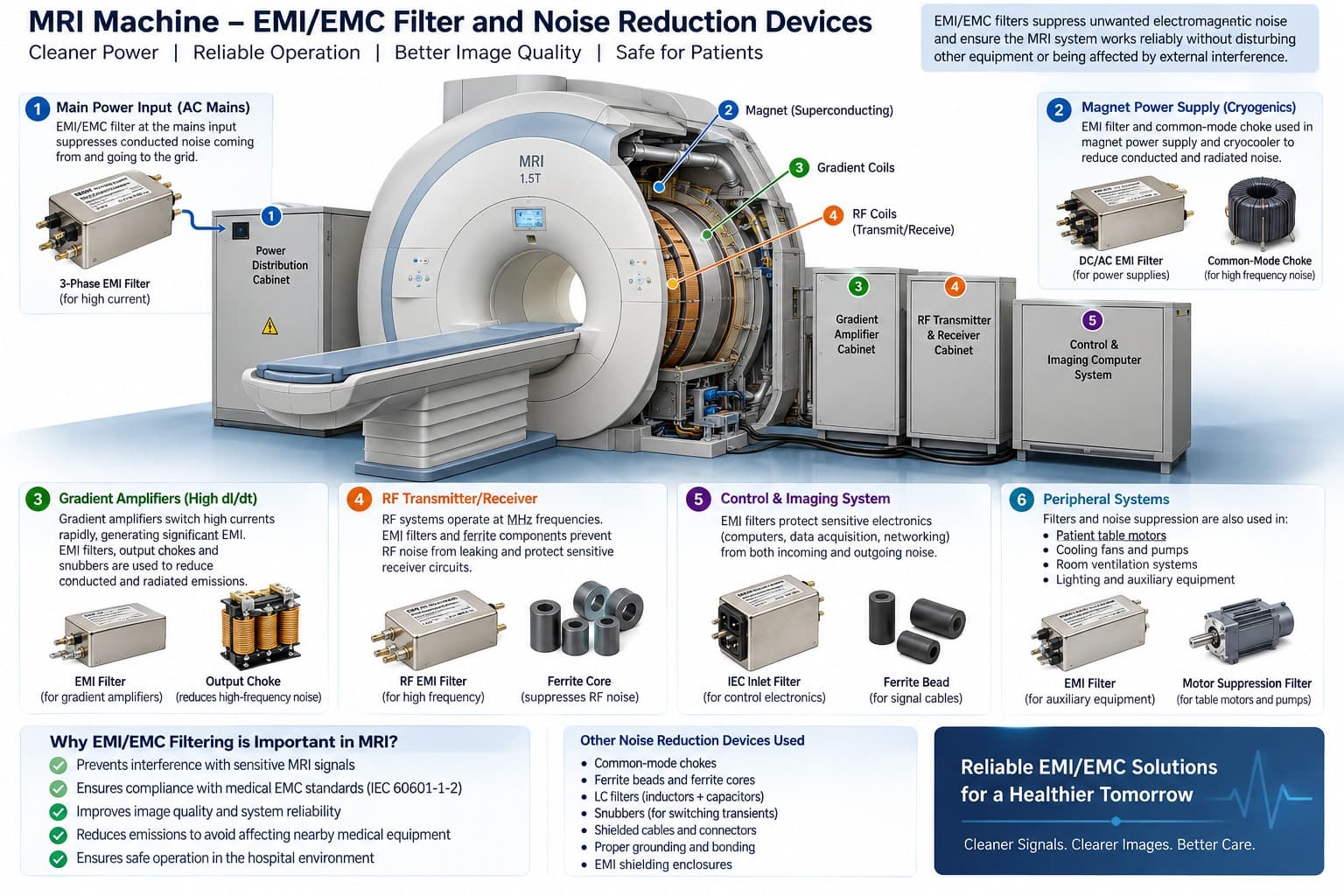
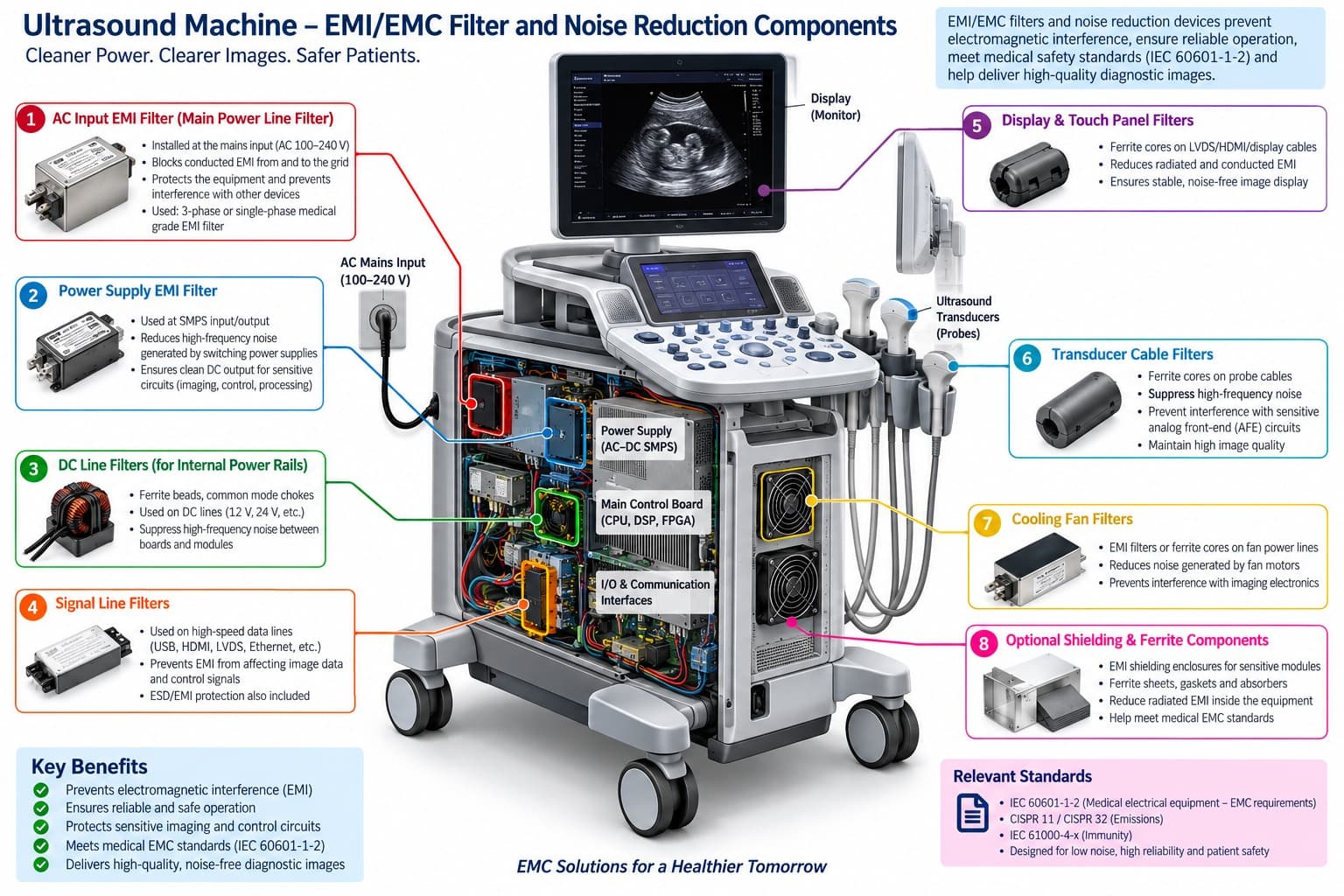
Medical imaging equipment presents some of the most demanding EMC challenges because it combines high-power electronics with extremely sensitive signal-processing and detection systems. Equipment such as MRI, CT, X-ray, ultrasound and other diagnostic imaging systems can contain high-speed switching electronics, precision analogue circuits, high-voltage power supplies and communication systems.
Unwanted electrical noise can couple into sensitive detection circuits or interfere with internal electronics. BLA can develop high-performance EMI filters, common-mode chokes, differential-mode filtering networks, DC filters and custom feedthrough filtering solutions for specific subsystems.
The filter architecture can be optimized around the frequency range requiring attenuation while maintaining the required power characteristics and electrical isolation.
Noise Suppression in Motors, Pumps and Actuators
Medical equipment frequently incorporates motors and actuators for pumps, fans, compressors, positioning mechanisms, cooling systems and automated movement. Motor-driven systems can generate additional EMI through switching devices, brushes, PWM drives and rapidly changing currents.
BLA can provide motor chokes, common-mode chokes, AC reactors, ferrite suppression and EMI filter assemblies to reduce unwanted high-frequency currents generated by motor-drive systems.
Where PWM motor control is used, high dv/dt at the motor terminals can also generate capacitive common-mode currents. Appropriate output-side filtering can help control the propagation of these high-frequency components.
Signal-Line and Sensor Noise
Medical equipment depends extensively on low-level signals from ECG electrodes, temperature sensors, pressure sensors, flow sensors, optical sensors, imaging detectors, encoders and other measurement devices. These signals can be particularly vulnerable to electromagnetic coupling.
BLA can develop signal-line EMI filters, common-mode signal chokes, feedthrough filters, ferrite beads and custom low-pass filtering networks for sensitive signal interfaces.
The key engineering challenge is achieving noise attenuation without degrading the desired signal. Therefore, filter design must consider signal bandwidth, impedance, rise time, attenuation characteristics and parasitic capacitance/inductance.
Communication and Data-Line EMI Filtering
Medical systems increasingly depend on digital communication between sensors, controllers, displays, monitoring systems and external networks. Interfaces can include CAN, RS-485, Ethernet, USB and other proprietary communication architectures.
High-frequency switching noise can couple into communication cables and cause data corruption, communication errors or intermittent operation. BLA can develop data-line filters, signal-line common-mode chokes, feedthrough filters and ferrite-based suppression solutions designed around the electrical characteristics of the communication interface.
For high-speed interfaces, the filter must be carefully designed because excessive capacitance or impedance can distort the signal waveform and compromise communication integrity.
EMI Suppression Capacitors
Capacitive filtering is a fundamental part of EMI suppression. BLA can incorporate X capacitors, Y capacitors and other EMI suppression capacitors into medical-equipment filter assemblies.
X capacitors are primarily used for differential-mode attenuation, while Y capacitors provide a controlled high-frequency path for common-mode currents subject to applicable safety and leakage-current constraints.
In medical equipment, capacitor selection requires particular attention to rated voltage, safety classification, leakage current, dielectric performance, temperature, lifetime and transient capability.
Feedthrough Filters and Chassis-Level Filtering
Where cables pass through a metal enclosure, feedthrough capacitors and feedthrough EMI filters can provide effective high-frequency filtering directly at the enclosure boundary. This prevents unwanted RF energy from travelling through cables into or out of the equipment.
BLA can provide customized feedthrough filters and chassis-mounted EMI filter assemblies for applications where enclosure-level filtering is required. Correct mechanical bonding between the filter body and conductive enclosure is important because even a small high-frequency impedance in the return path can reduce filter effectiveness.
EMC, Leakage Current and Safety Considerations
Medical equipment presents a particularly sensitive EMC design environment because EMI filtering cannot be considered independently from electrical safety. Increasing Y-capacitance, for example, may improve common-mode attenuation but can also increase leakage current. Similarly, filter inductance can improve attenuation but introduce voltage drop, power loss and thermal rise.
BLA therefore considers the relationship between EMI attenuation, leakage current, insulation, dielectric withstand, thermal performance, rated current, mechanical construction and system reliability when developing medical-equipment filtering solutions.
Customized BLA Solutions for Medical Equipment
BLA's capability extends beyond standard catalogue EMI filters. Medical equipment manufacturers may have highly specific requirements relating to enclosure dimensions, connector arrangement, rated voltage, current, leakage current, mounting configuration, frequency range and required attenuation.
BLA can develop customized combinations of single-phase EMI filters, DC EMI filters, common-mode chokes, differential-mode chokes, AC line reactors, DC reactors, ferrite cores, ferrite beads, X/Y capacitors, signal-line filters, data-line filters and feedthrough filters according to the actual application.
The engineering process focuses on identifying the noise source, frequency spectrum, coupling mechanism and victim circuit, followed by selection of the appropriate filtering topology and magnetic components.
BLA — Precision Noise Control for Medical Electronics
Medical equipment requires reliable electronics, clean power and controlled electromagnetic environments. From diagnostic and imaging equipment to patient monitoring systems, laboratory instruments, medical power supplies, pumps, motors and digitally connected medical devices, BLA provides application-specific EMI/EMC solutions designed to control unwanted electrical noise.
Whether the requirement is a single-phase EMI filter, DC EMI filter, common-mode choke, differential-mode choke, AC reactor, DC reactor, ferrite suppression component, EMI capacitor, signal-line filter, feedthrough filter or a complete multi-stage EMC filter, BLA focuses on solving the actual interference mechanism rather than simply adding a standard component.
BLA — Engineered EMI/EMC Solutions for Medical Equipment. Controlling electrical noise, protecting sensitive electronics and helping manufacturers achieve reliable electromagnetic performance.
Ready to revolutionize your Medical Equipment operations?
Contact Bla Etech today for a consultation and discover how our cost-efficient solutions can elevate your business while aligning with timely delivery.
Contact us

